Today is the “Shyamapana festival”. Shyamapana is a festival of forgiveness. This day is a culmination of a weeklong festival of repentance called “Paryushan”. So before I get into my study notes and reflection from Tattvartha Sutra, to quote an article:
For 357 days of the year we carry out our responsibilities to our business, our family and our career. We live a very busy, worldly life. In the process, we accumulate a lot of mental and emotional clutter. We gather unnecessary baggage of pride, fear, animosity, greed, ego and delusions in our thoughts and feelings. So Paryushan is the time to clear that clutter and make a bonfire to burn that junk, that rubbish which is corrupting our minds, our lives and our relationships. The Jains have designed the special eight days of Paryushan as a time of reflection, purification and renewal.
So over the last year if I have hurt your feelings in any way or form, please forgive me - “Michammi Dukkadam” and give me a mandate to start with a clean slate!
 Fig. Micchammi Dukkadam
For a number of years during the eight days of Jain Paryushan, I made it a discipline to learn something new and possibly read or study a spiritual book.
- In 2012, I read Nine Lives.
- In 2013 I read Conversations with God.
- In 2014 I read Good without God.
- In 2015 I read Siddhartha.
- In 2021 I did something different and did some art during the week of Paryushan.
- In 2024, I did a little bit of a tweak to this study and kind of went deeper into Jainism and memorized and refined Pratikraman.
This year in 2025, among other books I have read, I’m focusing on the study of Tattvartha Sutra. Sort of combining learning something new and going deep into Jainism. I also studied a bit of Bhagavad Gita and read “Thus Spoke Zarathustra”.
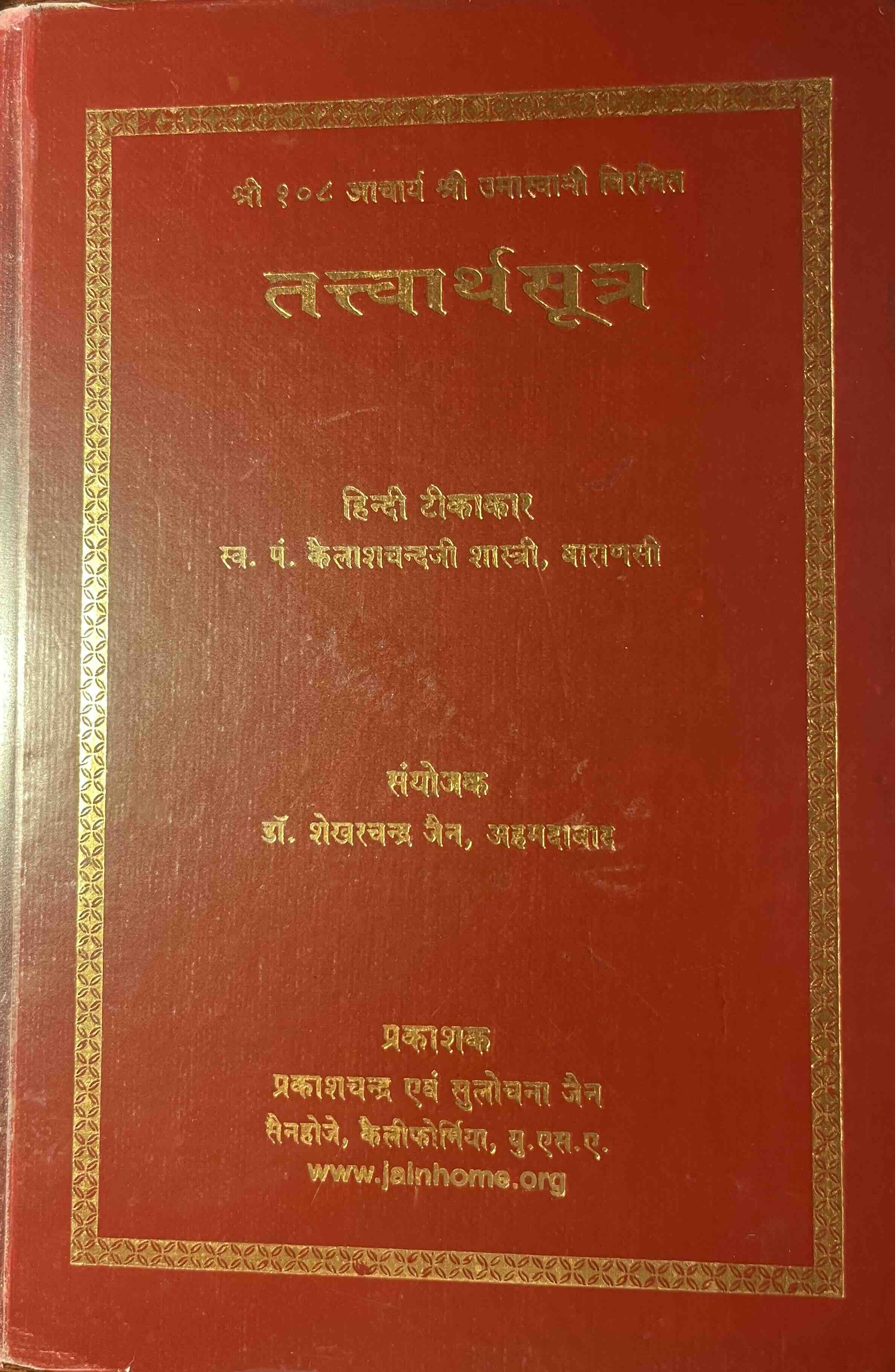 Fig. Tattvartha Sutra from my living room
The above book was sitting in my living room for the last few years, as my Mom was on and off studying from it. This year as I learned more about Jain history and scriptures, one thing became clear to me that the book Tattvartha Sutra has a special place in Jain literature. It is not only the prime text agreed upon by Digambars and Shvetambars, but also one which is succinct and covers the whole Jain philosophy in a concise and effective manner.
Saying that I read the book will not be fair. The way I want to present it is that I tried to study parts of the Tattvartha Sutra from three different books:
- That Which is Tattvartha Sutra by Nathmal Tatia - which itself is a compilation of ancient interpretation of Tattvartha sutra with the author’s viewpoint
- Tattvartha Sutra edited by Vijay Jain with explanations in English, and
- Tattvartha Sutra by Kailashchandra Shastri with explanation in Hindi.
It has 10 parts. It literally means “A Manual for Understanding All That Is”. They go from Faith, Asrava (influx of Karma) to Moksha (Liberation). It literally is the cliff notes of Jain philosophy and all that there is to know.
In this reflection of my study of the text, I’ll go chapter by chapter and mention the key verses which related to me and why.
The first part describes the nature of truth and the rest of the text elucidates on it. My favorite verse is:
जीवाजीवास्रवबन्धसंवरनिर्जरामोक्षास्तत्त्वम् ॥१.४॥
jīvājīvāsravabandhasaṃvaranirjarāmokṣāstatttvam ॥1.4॥
It literally lists all the truth categories:
- जीव (Jīva) – Soul, the conscious living entity.
- अजीव (Ajīva) – Non-soul, the non-living substances (matter, time, space, dharma, adharma).
- आस्रव (Āsrava) – Influx of karmic matter into the soul.
- बन्ध (Bandha) – Bondage, the binding of karma with the soul.
- संवर (Saṃvara) – Stoppage of karmic influx.
- निर्जरा (Nirjarā) – Shedding of accumulated karma.
- मोक्ष (Mokṣa) – Liberation, the complete freedom of the soul from karma.
The rest of the chapters describe these 7 truths!
 Fig. Jain Cosmology (source: wikipedia)
The second chapter describes the nature of soul. My favorite quote is:
संपूर्णगर्भोपपादा जन्म ॥२.३१॥
saṃpūrṇagarbhopapādā janma ॥2.31॥
Birth can be from accumulation of particles, reproduction or descent. Very specifically it says gods and higher beings are born by descent and lesser beings are formed by accumulation of particles.
For example, microorganisms and simple life forms emerge through sammūrchana (spontaneous generation from suitable matter), while celestial beings take birth through upapāda (instantaneous manifestation in their divine bodies).
This chapter is remarkable in terms of how accurately the thousands of years old Jain theory maps to modern biology, with its description of life forms.
The third chapter describes the lower & middle regions from Jain cosmology, and the fourth chapter describes the upper world of gods.
नास्थिता परापरे त्रिपल्योपमान्तमुहूर्ते ॥३.३८॥
nāsthitā parāpare tripalyopamāntamuhūrte ॥3.38॥
The maximum and minimum periods of lifetime of human beings are three palyopams and antamuhurta.
परा पल्योपममधिकम् ॥४.३९॥
parā palyopamamadhikam ॥4.39॥
Other gods live for more than one palyopam - the Jain measure of cosmic time.
I dwell on the above snippets to talk a little about Jain mathematics and numbers which can represent the infinitesimal and the uncountable. A palyopam is explained by the analogy of a pit 8 x 8 x 8 miles filled with hair particles from a seven-day-old newborn, with one particle removed every 100 years until the pit is empty - representing at least 10^194 years! The Jain mathematical system demonstrates how religious and philosophical needs drove the development of sophisticated mathematical concepts, centuries before modern mathematics grappled with similar ideas about infinity and infinitesimals.
The fifth chapter talks about the nature of non-living things - that includes matter, dharma, adharma, space and time! This chapter has one of the most famous phrases which is etched on the symbol of Jainism:
 Fig. Jain symbol
परस्परोपग्रहो जीवानाम् ॥५.२१॥
parasparopagraho jīvānām ॥5.21॥
Souls render service to one another.
This represents the fundamental principle of Jain ethics - that all living beings should help and support each other.
This chapter also talks about a unique view of accommodating different viewpoints in the Jain philosophy of non-absolutism or Anekantavad.
उत्पादव्ययध्रौव्ययुक्तं सत् ॥५.३०॥
utpādavyayadhrau vyayuktaṃ sat ॥5.30॥
Reality is characterized by origination, destruction, and permanence.
The eternal substance undergoes real transformation through changing modes while maintaining continuity of its essential nature. Substance and modes are two aspects of one reality - a conceptual distinction for understanding, not separate entities. Contrast this to the Philosophy of Being (like Vedanta): Reality is an unchanging eternal substance (Brahman); change is illusion. Philosophy of Becoming (like Buddhism): Only change is real; there is no permanent substance. For example, a gold ornament (substance) can be melted and reformed into different shapes (modes) - the gold remains constant while its manifestations change, illustrating how both permanence and change coexist in the same reality.
Chapter 6 is about Inflow of Karma (Asrava):
दर्शनविशुद्धिविनयसम्पन्नता शीलव्रतेष्वनतिचारी-ऽभीक्ष्णज्ञानोपयोगसंयमो शक्तितस्त्यागतपसी साधुसमाधिभेदावत्यकरणमर्हदाचार्यबहुश्रुतप्रवचनभक्तिरावश्यकापरिहाणिमार्गप्रभावना प्रवचनवत्सलत्वमिति तीर्थकरत्वस्य ॥६.२४॥
darśanaviśuddhivinayasaṃpannatā śīlavrateṣvanatichārī-‘bhīkṣṇajñānopayogasaṃyamo śaktitastyāgatapaśī sādhusamādhivedāvatyakaraṇamarhddācāryabahutapravachanabhaktiravāśyakāparihāṇimārgaprabhāvanā pravāchanavatsalatvamiti tīrthakaratvasya ॥6.24॥
This is a complex compound describing the qualities required for Tīrthakaratva:
Purity of vision (darśana-viśuddhi),
Proper conduct and vows (śīla-vrata),
Knowledge and meditation practices,
Devotion to the Arhants, Ācāryas, and learned ones,
Compassion for all beings on the religious path.
The 5 vows of Jainism are described in chapter 7. Mahavira as the 24th Tirthankar or teacher added the 5th vow of celibacy:
हिंसानृतस्तेयाब्रह्मपरिग्रहेभ्यो विरतिव्रतम् ॥७.१॥
hiṃsānṛtasteyābrahmaparigrahebhyo viratirvatam ॥7.1॥
The vows consist of abstention from
हिंसा (hiṃsā) - violence/harm,
अनृत (anṛta) - falsehood/lying,
स्तेय (steya) - stealing,
अब्रह्म (abrahma) - sexual misconduct/unchastity,
परिग्रह (parigraha) - possessiveness/attachment.
This chapter talks about small and big vows and also describes sallekhanā or saṃthārā - the Jain practice of voluntary death through gradual fasting, undertaken when one feels spiritually prepared and often when facing terminal illness or extreme old age. It’s considered the ideal way to end life in Jainism, allowing one to die in a state of equanimity while minimizing harm to other beings.
The truth of Bandh (karma formation) is described in chapter 8, Samvar (stoppage) and Nirjara (removal of karma) are discussed in chapter 9. So this covers the very short and detailed karma theory of Jainism.
ज्ञानदर्शनावरणवेदनीयमोहनीयायुर्नामगोत्रान्तरायाश्च ॥८.१॥
jñānadarśanāvaraṇavedanīyamohanīyāyurnāmagotrāntarāyāśca ॥8.1॥
Eight types of karmas which impede a soul from reaching nirvana
उत्तमा क्षमा-मार्दव-आर्जव-शौच-सत्य-संयम-तपस्-त्याग-आकिञ्चन्य-ब्रह्मचर्याणि धर्मः ॥९.६॥
uttamā kṣamā-mārdava-ārjava-śaucha-satya-saṃyama-tapas-tyāga-ākiñchanya-brahmacharyāṇi dharmaḥ ॥9.6॥
Dharma/Morality consists of perfect
forgiveness, humility, straightforwardness,
purity (freedom from greed), truthfulness,
self-restraint, austerity, renunciation,
detachment, and continence.
This snippet forms the foundational scriptural basis for the Das Lakshan in Digambar Jainism. The 10-day Das Lakshan Parva directly corresponds to these ten dharmas, with each day traditionally dedicated to contemplating and practicing one specific virtue. This creates a systematic spiritual discipline based on this scriptural foundation. These 10 days of celebration usually start as soon as the Shyamapana ends!
Chapter 10 is short and talks about Moksha or Liberation:
कृत्स्नकर्मक्षयो मोक्षः ॥१०.२॥
kṛtsnakarmakṣayo mokṣaḥ ॥10.2॥
Elimination of all types of karma is liberation
Thus said Umasvami!