Book review of Runnin’ Down a Dream: How to Thrive in a Career You Actually Love by Bill Gurley
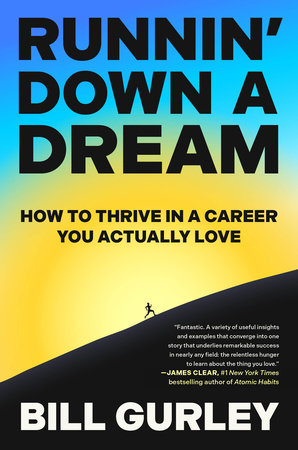
Bill Gurley made his name backing Uber, OpenTable, Zillow, the kind of resume where you’d expect a book about spotting winners. Instead he spent a decade chasing a much smaller question: why do some people end up loving what they do while others just tolerate it for forty years? He doesn’t answer it himself. He goes and finds restaurateurs, talent agents, coaches, executives, sits them down, and lets their actual choices make the case for him. It reads less like a career guide and more like a stack of case files, each one a different person who figured out how to stay in motion toward something.
Major Topics Covered
1. Chase Your Curiosity
Gurley opens with Jerry Seinfeld, who argues that “fascination” beats “passion” as a compass. Passion is something you’re supposed to already feel, like it should arrive fully formed. Fascination you can go hunting for, the way you’d follow a smell in a kitchen until you find the pot it’s coming from. He backs this up with Angela Duckworth quietly walking back her own grit research: perseverance was never the hard part. Finding the thing worth persevering at is.
2. Follow the Fire, Even When It’s Inconvenient
The opening profile is Danny Meyer, headed toward law school like everyone expected, until an uncle basically dared him to go do food instead. Meyer took a pay cut to apprentice in a kitchen, then spent his own money touring restaurants across Italy and France like it was research for a thesis nobody assigned him. He eventually figured out his real gift wasn’t cooking, it was the floor, the dining room, reading a table the way a good bartender reads a face. He picked a neighborhood nobody else wanted yet for his first restaurant, betting on where the city was headed rather than where it already was, and built a menu that was basically a map of everywhere he’d been. It’s a good antidote to the idea that you need the whole plan before you’re allowed to start.
3. Embrace Your Peers
This is the one that stuck with me. Gurley’s point is that nobody builds a career solo, and the people standing next to you end up mattering as much as anyone above you, because they’re in it with you for decades, not just a season. It put language on something I already believed but had never quite said out loud: coaching doesn’t have to run downhill. Some of the best coaching I’ve gotten came sideways, from someone a step ahead of me on one thing and a step behind me on another.
It also had me thinking about my own path. I wanted to be a mathematician as a kid, for reasons I can’t fully explain even now, until I realized that particular dream doesn’t pay rent. So I drifted to computer science, close enough to math to still feel honest. But what I actually wanted was never to go deep on one thing, it was to stand where two or three fields overlapped and see what fell out of that. I’m 46 now and still don’t have a fixed destination. What I have is closer to a compass heading: keep pushing on my own ceiling, keep looking for the next edge to test myself against. Mentors built a lot of that in me. Teaching sharpened it further, since explaining something badly to a room is the fastest way to find out you didn’t understand it yourself. And working alongside good peers did the rest, which is more or less Gurley’s whole argument, minus the book deal.
4. Go Where the Action Is
The logic here is simple: standing near where things are actually happening compounds in a way raw talent alone never does, the same reason nobody becomes a great surfer studying waves from the parking lot. This one landed for me because of my own early career, when I picked the busier, noisier option over the safer one without being able to explain why at the time. Turns out that was the whole point.
5. Give Back
The last principle is that success starts paying interest once you give pieces of it away, mentoring someone, teaching, holding a door open that used to be shut. Gurley treats this as a duty. In my own experience, especially later in my career, it’s never once felt like one. Giving back has been one of the more selfish things I do, honestly, because whatever I hand off, I walk away having gotten at least as much back internally.
What I’d Tell My Niece
If I boiled this whole book down for a high schooler picking a direction, someone like my niece right now, ruling out entire futures because “I don’t like math” or “I don’t like physics,” I wouldn’t start with the subject at all. I’d tell her to go toward whatever lights the fire, the thing where hours disappear and you don’t notice you’re tired until someone points it out, because that fire carries you further than raw aptitude ever will. Go stand where the action is, don’t wait until the dream is fully formed to start moving. And know you can’t do this by yourself. At every stage you’ll need mentors and you’ll need peers, and the sooner your peers stop being just people around you and start being part of the whole climb, the better off you’ll be. Curiosity isn’t optional, no matter what it happens to be curious about. But fire without discipline just burns out fast. You still have to show up on the days the fire isn’t lit and do the boring part anyway.
Conclusion
Runnin’ Down a Dream isn’t really a formula, it’s a pile of proof points: Danny Meyer’s kitchen, Gurley’s own detour into venture capital, a handful of other people who took the weirder route and made it stick. None of them did it alone, and none of them got it right on the first try. Four out of five from me, a book that’s better for looking back at the choices you’ve already made than for plotting the ones still ahead, though it’s got something for both.