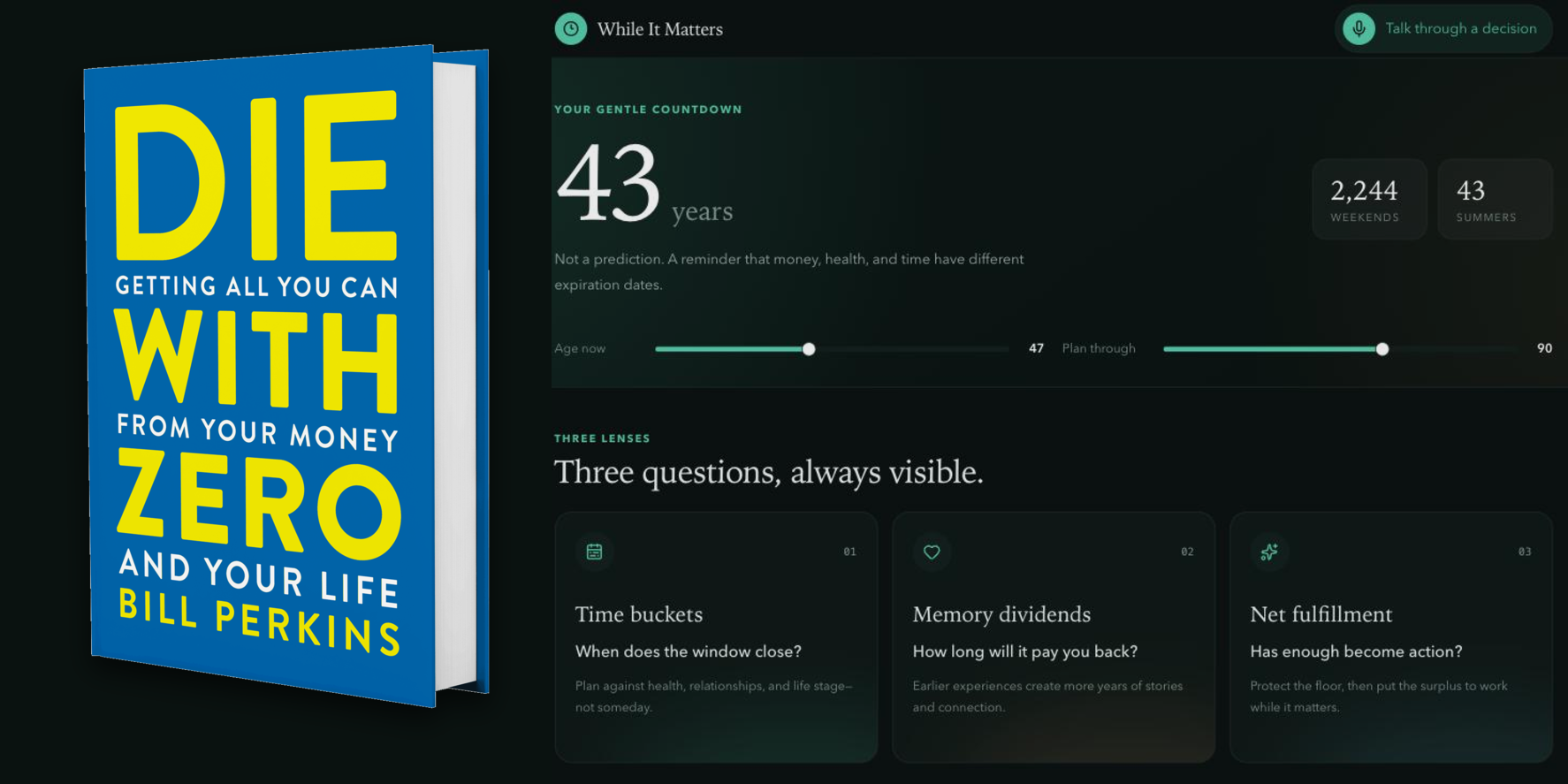
Book review of Die With Zero: Getting All You Can from Your Money and Your Life by Bill Perkins, next to the “gentle countdown” screen of While It Matters, an app I built to sit with this book’s questions.
I read this book during Paryushan week this year, which felt fitting. Paryushan is a week I set aside for reflection and reckoning, and I decided to listen to Bill Perkins’s Die With Zero because I have always had a complicated relationship with money.
When you do not come from a wealthy background and have worked hard for what you have, the natural instinct is to keep accumulating. You save, invest, and prepare for uncertainty. The common wisdom is that enough money is never quite enough. Every milestone is followed by another, and security gradually becomes indistinguishable from accumulation.
I have never been entirely comfortable with that idea. Money should have some value beyond merely appearing in an account. It should do something. It should support people, create experiences, provide freedom, or solve problems. Otherwise, accumulating it can become an end in itself.
Die With Zero gave me a useful framework for thinking about money as a resource rather than simply something to accumulate.
The title is intentionally provocative. Perkins is not really suggesting that we calculate our final day perfectly and spend our last dollar just before midnight. That would be impossible. His larger argument is that we should use our money at the points in life when it can create the most value.
Money has a time dimension. A dollar is not equally valuable at every age or in every circumstance.
There are people in my life who would benefit from help today far more than they would benefit from an inheritance many years from now. I have friends who are sick and family members who need help with education. For them, the timing of the help may matter as much as the amount. Money given at the right moment could change the course of a life. The same money received twenty years later might provide comfort, but not transformation.
This was one of the book’s most persuasive ideas: if we intend to give money to our children, family, friends, or charitable causes, why wait until we die? An inheritance commonly arrives after the recipient has passed through the years when it could have mattered most. People may receive money after they have already raised their families, paid for education, established careers, and bought homes.
Giving during our lifetime also allows us to participate in the result. We can see someone receive an education, recover from a difficult period, begin meaningful work, or simply experience some relief. We can offer judgment, attention, and encouragement along with the money. The gift becomes part of a relationship rather than a transaction written into an estate document.
The book’s argument about experiences was equally powerful. Some experiences cannot simply be postponed.
There are trips I want to take with my family and outdoor activities I want us to do together. Skiing in Japan, for example, may be possible and enjoyable now. Ten years from now, our health, responsibilities, interests, and family dynamics may be different. Even if we still have the money, the opportunity itself may no longer exist.
Perkins describes experiences as producing “memory dividends.” A meaningful trip is not consumed only during the week in which it occurs. It continues through photographs, stories, relationships, and memories. In that sense, an experience purchased at the right time can produce returns for decades.
This does not mean that every expensive experience is worthwhile. It means that some uses of money have a limited window. Saving money for an experience until we can no longer have it is not prudence. It is a planning failure.
The discussion of annuities also changed how I think about retirement. One reason people continue accumulating — and remain reluctant to spend — is that no one knows how long retirement will last. Even a person with substantial savings may worry about living longer than expected, facing healthcare expenses, or encountering a prolonged market downturn.
Guaranteed lifetime income can address part of this uncertainty. An annuity can cover a defined portion of retirement expenses for as long as a person lives. Its psychological value may be as important as its financial value. If I knew that my essential retirement needs were covered, I would feel more comfortable using the rest of my money now.
In that sense, an annuity is not simply an investment. It can provide permission to spend.
Of course, the implementation is more complicated than the principle. Annuities differ in cost, inflation protection, liquidity, and insurer risk. Healthcare and long-term-care expenses remain uncertain. It would be foolish to give away or spend so much that we become dependent on others. A responsible version of “die with zero” still requires a strong financial floor.
But that is different from preserving every possible dollar against every imaginable risk.
Most of my wealth has been built for security and accumulation. That was necessary, and it reflects where I came from. The challenge now is deciding when security has been adequately funded and accumulation should stop being the default objective.
That may be the most important question raised by the book: At what point does saving for the future begin to take resources away from the life we could be living now?
I do not interpret Die With Zero as an argument for reckless spending. I interpret it as an argument against passive accumulation. It asks us to decide consciously what our money is for, whom it should help, and when it will have the greatest effect.
The goal is not necessarily to die with exactly zero dollars. The goal is to avoid dying with a large inventory of postponed experiences, delayed generosity, and unused intentions.
Money is stored possibility. Its value is realized only when we convert it into something that matters.
Building a small app to sit with the question
The book’s ideas stayed with me enough that I built While It Matters, a small app that turns the abstractions into numbers you can actually look at: a gentle countdown of years, weekends, and summers left against a chosen planning horizon, and three lenses drawn straight from the book — time buckets (when does the window close?), memory dividends (how long will an experience pay you back?), and net fulfillment (has enough become action?). It is less a financial calculator than a nudge, a screen I can return to when I catch myself defaulting back to accumulation.