Micchami Dukkadam — forgiveness as a return to friendship and coexistence.
Today is Samvatsari, the culmination of Paryushan and the Jain day of forgiveness.
Each year I use the eight days of Paryushan to go deeper into some Jain practice. Last year it was reading parts of the Tattvartha Sutra. This year I wanted something more embodied, so I chose to carry a few verses in memory rather than only read them: the opening three verses of the Bhaktamar Stotra, Acharya Manatunga’s Sanskrit hymn to Rishabhanatha, the first Tirthankara. Tradition surrounds its composition with chains breaking verse by verse — a verse remembered and understood can loosen a chain.
Samvatsari and forgiveness
Samvatsari asks us to look backward before starting again — to examine the harm we may have caused knowingly or unknowingly, in thought, speech, or action, and to seek forgiveness without first building a defense. Michhami Dukkadam is often translated simply as “please forgive me,” though its literal sense is closer to may my wrongful actions become fruitless. The fuller prayer goes further:
खामेमि सव्व जीवे, सव्वे जीवा खमन्तु मे। मित्ति मे सव्व भूएसु, वेरं मज्झ न केणइ॥
I forgive all living beings. May all living beings forgive me. May I have friendship with all and enmity with none.
Forgiveness is easy to say and hard to practice — it asks us to lower the ego, admit our view is incomplete, and reach toward another person without knowing how they’ll respond. That is where the first three verses of Bhaktamar started to feel connected to Samvatsari for me.
Verse one: bow
भक्तामर-प्रणत-मौलि-मणि-प्रभाणा-
मुद्योतकं दलित-पाप-तमो-वितानम् ।
सम्यक् प्रणम्य जिन-पाद-युगं युगादा-
वालम्बनं भव-जले पततां जनानाम् ॥१॥
bhaktāmara-praṇata-mauli-maṇi-prabhāṇām
udyotakaṁ dalita-pāpa-tamo-vitānam
samyak praṇamya jina-pāda-yugaṁ yugādāv
ālambanaṁ bhava-jale patatāṁ janānām
A bow to the Jina’s feet, which light up the jewels on devotees’ bowed heads, disperse the darkness of wrongdoing, and support those falling into the ocean of worldly existence.
Before Manatunga says anything grand, he bows. Samvatsari asks the same posture: an apology offered from a position of superiority isn’t much of an apology. The verse’s image stays with me — when falling into the waters of ordinary life, the first need isn’t an argument, it’s an ālambana, a handhold.
Verse two: speak
यः संस्तुतः सकल-वाङ्मय-तत्त्व-बोधा-
दुद्भूत-बुद्धि-पटुभिः सुर-लोक-नाथैः ।
स्तोत्रैर्जगत्-त्रितय-चित्त-हरैरुदारैः
स्तोष्ये किलाहमपि तं प्रथमं जिनेन्द्रम् ॥२॥
yaḥ saṁstutaḥ sakala-vāṅmaya-tattva-bodhād
udbhūta-buddhi-paṭubhiḥ sura-loka-nāthaiḥ
stotrair jagat-tritaya-citta-harair udāraiḥ
stoṣye kilāham api taṁ prathamaṁ jinendram
Greater beings, with far deeper knowledge, have already praised the first Jina with magnificent hymns — and still Manatunga says: I too will praise him.
Sincerity isn’t made unnecessary by inadequacy. No one else can perform my act of gratitude, confession, or forgiveness for me. It’s tempting to send the familiar phrase to everyone and leave the harder conversations untouched. Ritual language earns its keep only when it opens the door to specific language: I was impatient. I spoke carelessly. I did not listen. Please forgive me. Verse two is the courage to add one’s own small voice.
Verse three: reach
बुद्ध्या विनापि विबुधार्चित-पाद-पीठ!
स्तोतुं समुद्यत-मतिर्विगत-त्रपोऽहम् ।
बालं विहाय जल-संस्थितमिन्दु-बिम्ब-
मन्यः क इच्छति जनः सहसा ग्रहीतुम् ॥३॥
buddhyā vināpi vibudhārcita-pāda-pīṭha
stotuṁ samudyata-matir vigata-trapo’ham
bālaṁ vihāya jala-saṁsthitam indu-bimbam
anyaḥ ka icchati janaḥ sahasā grahītum
Manatunga admits he may lack the ability for what he’s begun, yet proceeds without shame — like a child who sees the moon reflected in water and reaches out to grasp it. An adult knows the reflection can’t be held; the child reaches anyway, and wonder overcomes self-consciousness.
This may be my favorite of the three, because it gives dignity to the imperfect attempt. We postpone the apology until we can phrase it perfectly, postpone forgiveness until it’s been earned, postpone practice until we feel ready. The child reaches now. Forgiveness carries the same uncertainty: I can ask for it but not demand it, offer it but not rewrite what happened — reach toward the moon in the water while knowing some distance remains.
From reading to reciting
Memorizing Sanskrit has been humbling — I can understand the meaning and still lose the next line while walking. So I built a small Bhaktamar Walk Practice app: it presents the first three verses one line at a time, lets me hide the line and speak it aloud while walking, and moves forward when the browser recognizes enough of it. Nothing is stored; the speech recognition is deliberately forgiving. There’s something fitting about imperfect software helping with imperfect recitation — the score was never the point. Returning to the line is.
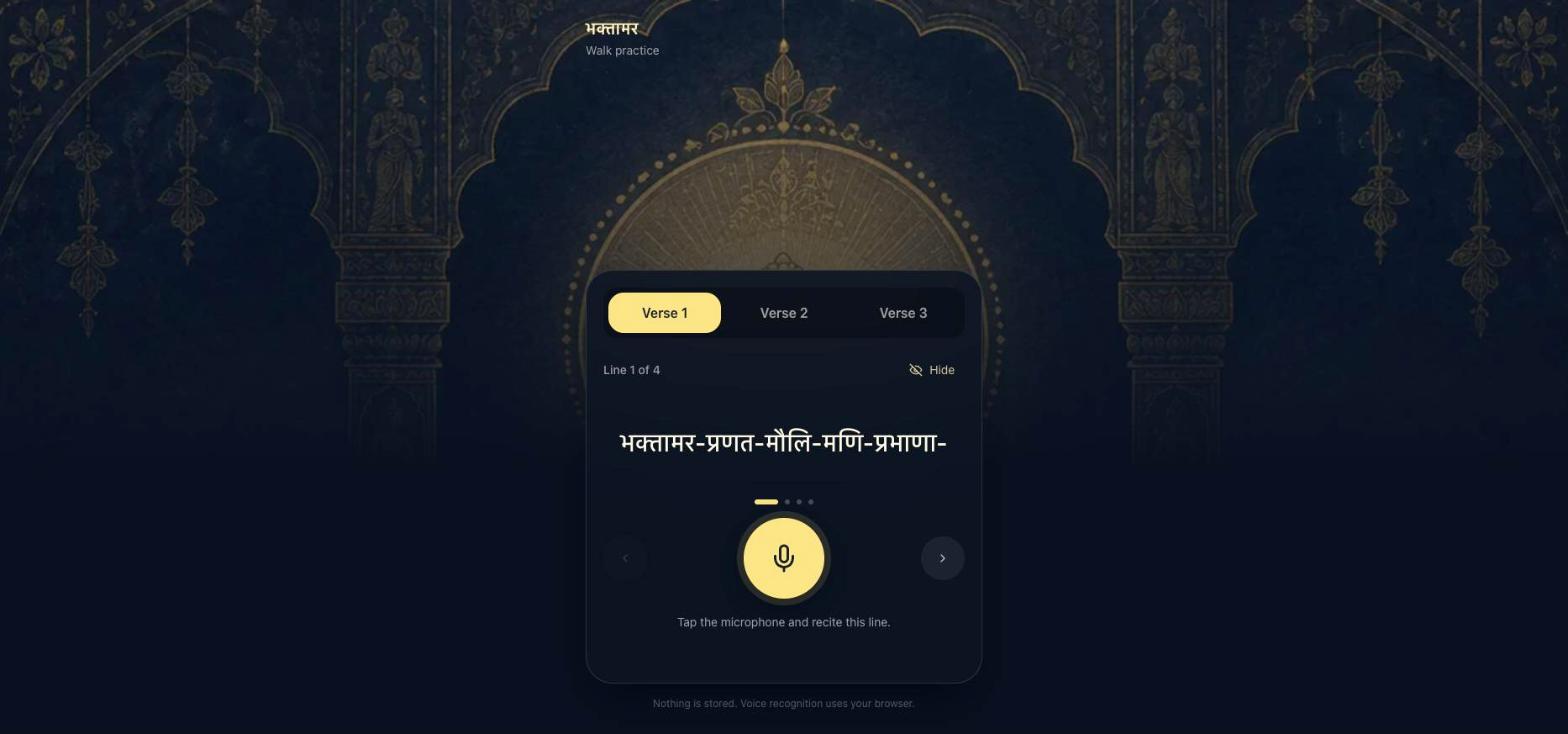
Bhaktamar Walk Practice — a line-by-line walking and recitation companion.
The three verses now form a small sequence for me: bow — put the ego down and find a handhold; speak — add your voice even when greater voices already exist; reach — make the sincere attempt without waiting to become perfect. It’s also a useful sequence for Samvatsari: bow enough to recognize the harm, speak the apology in your own words, reach toward reconciliation without controlling the result.
As this Paryushan closes, I ask forgiveness from all those I may have hurt knowingly or unknowingly, in thought, word, or action — and I want to release the injuries I still carry, since asking for forgiveness while refusing to forgive would leave the practice incomplete.
Michhami Dukkadam. May my wrongful actions become fruitless. May all living beings forgive me. May I have friendship with all and enmity with none. And when the ideal feels as distant as the moon reflected in water, may I still have the innocence to reach.