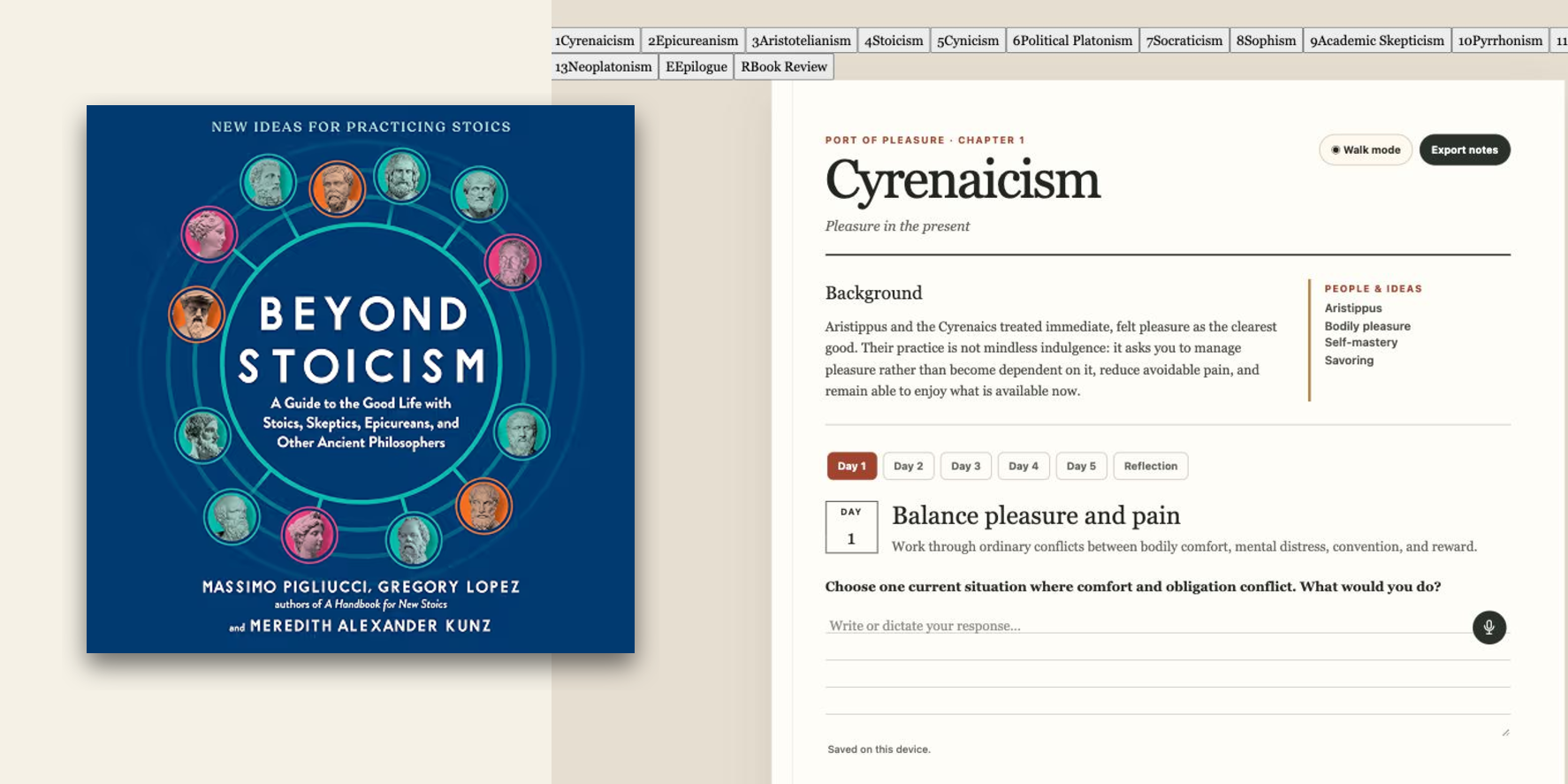
Book review of Beyond Stoicism: A Guide to the Good Life with Stoics, Skeptics, Epicureans, and Other Ancient Philosophers by Massimo Pigliucci, Gregory Lopez, and Meredith Alexander Kunz, next to Beyond Stoicism — Digital Workbook, a companion notebook I built to work through the book chapter by chapter.
A friend recommended Beyond Stoicism to me about a year ago. In his family, philosophy was a regular dinner-table subject rather than something confined to a classroom. His recommendation stayed with me, and I read the book and worked through its exercises during last year’s Paryushan. This Paryushan I came back to it and built the companion workbook, so the review and the tool are separated by a year but tied together by the same week of reflection.
That second part matters. Beyond Stoicism is not simply a survey of ancient Western philosophy. It is an invitation to try several philosophies and observe how each changes the way you understand a problem, an emotion, or a decision.
One of the clearest distinctions for me was between Stoicism and the Socratic method. Stoicism asks us to distinguish what is within our control from what is not. We cannot fully control events, outcomes, other people, or even our own bodies. We can, however, examine our judgments and choose how we respond. This is especially valuable when circumstances resist our plans.
The Socratic method performs a different kind of work. It asks us to examine what we think we know. What exactly do we mean by justice, courage, success, or happiness? What assumptions support our definitions? Do those definitions survive counterexamples? Stoicism can help us respond wisely to a difficult situation; Socratic inquiry can reveal that we may not understand the situation as well as we initially believed.
The book also corrected some common misconceptions. Epicureanism, for example, is often understood as the pursuit of indulgence. But Epicurus was not advocating endless consumption or constant sensual pleasure. His deeper concern was tranquility: learning what is enough, distinguishing necessary desires from manufactured ones, and freeing ourselves from avoidable fear and dissatisfaction.
This is where the book becomes more than a history of philosophy. Stoicism, Epicureanism, Aristotelian virtue, Socratic questioning, Cynicism, and the skeptical traditions do not provide one unified answer. Instead, they offer different instruments. One helps us regulate our response to events. Another examines our desires. Another develops character through repeated action. Another questions whether our confidence is justified.
The value lies in learning when to use each instrument rather than forcing every problem through one philosophy.
I found this pluralistic approach particularly interesting from a Jain perspective. The Jain principle of anekantavada teaches that reality has many aspects and that no single, limited standpoint captures the whole of it. This does not mean that every claim is equally true. It means that our understanding becomes more complete when we recognize the conditions and perspectives from which different claims arise.
Beyond Stoicism performs something similar. It asks us to view the good life through multiple philosophical lenses. A Stoic, an Epicurean, an Aristotelian, and a skeptic may examine the same experience and notice different parts of it. Their conclusions may conflict, but those conflicts can deepen rather than weaken our understanding.
There is also an interesting tension with Jain ideas of renunciation, restraint, and penance. Jain traditions often place great value on reducing attachment and limiting desire. Yet most of us live in families, participate in society, and engage with material life. For such a person, the Epicurean idea of moderation and tranquility may offer a useful middle path: worldly pleasures need not be rejected completely, but neither should they control us. The question becomes whether we can enjoy what is available without turning enjoyment into attachment.
That may be the book’s most practical lesson. We do not necessarily need to become Stoics, Epicureans, Cynics, or skeptics. We can learn from each tradition, test its practices, and gradually assemble a more thoughtful way of living.
To accompany this review, I created an interactive reflection guide based on the philosophical journey in the book. It introduces each school, offers original questions for personal reflection, and allows readers to dictate or write their responses. The goal is not to replace the book or its workbook, but to let readers experience its central idea: philosophy becomes meaningful when we practice it against the circumstances of our own lives.
Beyond Stoicism succeeds because it treats ancient philosophy not as a museum of old ideas, but as a workshop. Its philosophies sometimes reinforce one another and sometimes disagree sharply. That is precisely their value. A good life may require tranquility in one moment, courage in another, skepticism in a third, and the humility to recognize that no single perspective is complete.